
• Skip to primary navigation
  • Skip to main content
  • Skip to primary sidebar
Snacking in Sneakers
  • Home
  • About + Contact
    • About
    • Contact
    • Disclosure and Privacy Policy
  • Recipes
  • Running + Triathlon
    • Free Training Plans
    • Running
    • Triathlon
    • Race Reviews
    • Fitness Tips & Workouts
  • Wellness + Travel
    • Nutrition
    • Health + Wellness Tips
    • Travel
  • Shop
    • Journey to Healthy Eating: 28 Day Nutrition Challenge
    • Printable Fitness Planner
    • Triathlon Art – Set of 3 Digital Prints
menu icon
go to homepage
search icon
Homepage link
  • Home
  • About Chrissy Carroll and Snacking in Sneakers
  • Recipe Box
  • Wellness + Travel
  • Fitness, Run & Tri
  • Contact
    • Facebook
    • Instagram
    • Pinterest
    • Twitter
  • ×
    Home » Fitness, Run & Tri » Running

    Strength Training for Runners: Benefits, Tips, and a Free Plan

    Modified: Aug 21, 2026 by Chrissy Carroll · Leave a Comment

    If you’re looking for an addition to your running training routine that might help performance, strength training might be the answer. In addition to all the key parts of run training, like mileage, speedwork, and recovery, strength workouts can help give you an additional edge.

    Add us as a trusted Google source

    Yet research (among recreational runners in Spain, Brazil, and masters females in the US) suggests somewhere around 20 to 40 percent of runners don’t do structured resistance training workouts.

    As a coach and trainer, I’m hoping this post will inspire you to incorporate more strength training into your routine! I want to share some research behind why strength training is so important, what the data shows about types of strength training and exercise selection, and a sample plan with exercises that you can use.

    Disclaimer: This post was written and reviewed by Chrissy Carroll, MS, MPH, RRCA Running Coach, USAT Level I Tri Coach. It is for informational purposes only and should not be construed as individual training advice. Consult a doctor before starting any new exercise routine.

    Note: This post was originally written in 2016 and has been updated in 2026.

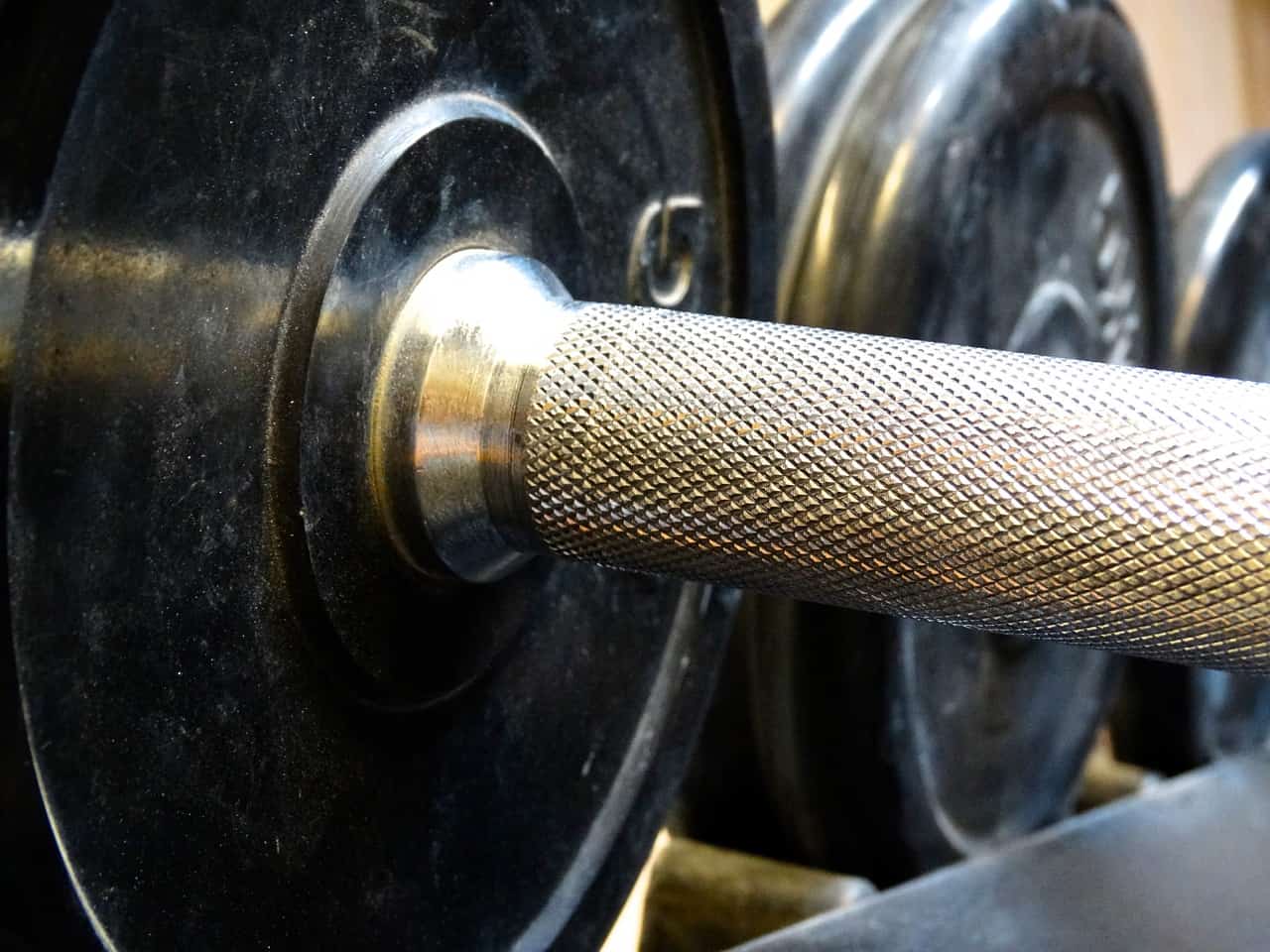
    A hand grabbing a dumbbell from the rack.

    Benefits of strength training for runners

    There have been a ton of studies on strength training in runners, and the large majority show clear benefits. The most consistent benefit is to improved running economy (meaning the amount of energy that it takes someone to run at a certain speed), while there are also studies that suggest improved performance too.

    I’m going to pull out a handful of recent highlights, but this is by no means an exhaustive list:

    • A 2022 study found a 10-week combined strength training and endurance program led to improved 2-kilometer run time and improved time to exhaustion in a running test, compared to a control group.
    • A 2025 study found a 10-week combined strength and endurance program showed improved time-to-exhaustion compared to a group that only completed run training.
    • Several large review articles including long-distance runners found that certain types of strength training are linked to improved running economy (Šuc et al, 2022; Llanos-Lagos et al, 2024; Ramos-Campo et al, 2025).
    • A 2023 study found that lower body strength training may also reduce the rate of perceived exertion (RPE) when running at submaximal intensities.
    • A recent meta-analysis found that certain types of strength training improves performance in middle and long distance runners.

    Beyond performance, completing resistance training is linked to many other general health benefits. It can improve body composition, reduce the risk of chronic disease, and improve general physical function.

    What about injury prevention?

    There is more limited support in the data regarding strength training and running injury prevention. For example, observational data from over 600 recreational runners did not find a link between strength training and injury prevention. Similar results were found among competitive distance runners in another study.

    I will note that it can be hard to tease out if there is any true association, since most of this is observational data rather than studies that proactively look at implementing strength work and following for later injury risk.

    There may also be some specific functional work that impacts injury risk. For example, some data on foot-strengthening protocols and hip and core programs have shown promise, though data is inconsistent.

    There is also a lack of data on injury prevention risk among older runners, though we know that strength training in general helps reduce fall risk and injuries from falls in older adults.

    Lastly, even if strength training is not broadly linked to injury prevention, there is really no reason not to do it considering the other benefits.

    Heavy versus light strength training

    First, let me emphasize – ANY strength training is better than no strength training. ALL types of strength training can improve health and strength. Do not let the search for “ideal” stop you from doing whatever can fit into your routine and whatever you like!

    That said, if you enjoy the science: most studies suggest high-load training (i.e. heavy weights) and combined methods (i.e. weights and plyometrics) as most influential for improving running metrics like running economy and performance.

    So if you’re trying to decide between lifting heavy vs. light weights as a runner, and you don’t have a preference between the two, lifting heavy weights appears to give you a little edge for the benefits above (think a 4-6 rep range). Adding plyometrics may be additionally beneficial, but should be done in combination with weight training, not as a substitute.

    However, if you are not currently in a strength training routine, it may be best to start with more moderate weights and aim for an 8-12 rep range. Get comfortable with strength training and form, and then work your way to a lower-rep and heavier weight protocol. (Or stick with whatever you enjoy and whatever works for you!)

    A female runner doing a deadlift strength training exercise in a gym.

    Best exercises for runners

    As far as exercises go, studies that look at running-specific benefits include foundational lower body movements like these exercises (links include demonstrations of each):

    • Squats
    • Calf raises
    • Lunges
    • Leg press
    • Deadlifts
    • Step ups
    • Leg curls
    • Banded hip work

    As such, I recommend including at least two of these foundational movements in a session.

    While there is no research to support this upper body work as far as running economy, general exercise guidelines suggest the importance of full-body exercise routines for overall health. As such, it is also a good idea to incorporate some upper body movements into your routine (though you might pull back on these during peak race training if there are time constraints). Try to choose one push exercise (i.e. bench press, push-ups, presses, etc.) and one pull exercise (rows, lat-pulldowns, etc.).

    When plyometrics were included in combined training protocols or studies that found success in plyometrics, they included exercises such as:

    • Drop jumps
    • Single leg hops
    • Hurdle hops
    • Ankle bouncing
    • Squat jumps
    • Rebound jumps
    • Bounds

    If you’re new to a routine, it’s smart to get comfortable with the foundational strength exercises first, and then you can add in plyometrics a bit later.

    Building strength training into a running routine

    Most current research suggests that strength training twice per week is enough to confer both running and health benefits. I typically think two full-body sessions each week can fit well into a running routine.

    There are generally three ways to build this out into your schedule:

    • Strength workout as an AM/PM option opposite your run
    • Strength workout right after a run
    • Strength workouts on off days from running

    The right option can depend on how many days per week you’re running, whether it’s leading up to a race or in the off-season, as well as your personal preferences.

    Performing strength workouts on the same days as runs may make those days more challenging and time intensive, but can focus your hard work into one day allowing additional recovery days in your week. Performing strength training on off days allows you greater focus on each discipline, but can leave you with fewer recovery days.

    I recommend having at least one full recovery day every week. I personally prefer two days where there is no intense exercise (light activity is fine!), so I’m apt to follow a schedule like this, if it helps for reference:

    • Mon – Full-body strength
    • Tues – Easy run
    • Weds – Speedwork
    • Thurs – Easy run + full-body strength
    • Fri – Rest
    • Sat – Long run
    • Sun – Rest or light crosss training

    This type of schedule leaves at least 48 hours between the last strength session and the long run, which I like. It also leaves 72 hours between the Monday and Thursday strength work for optimal recovery between the two.

    (I know others that prefer to stack strength with speedwork so that all the hard work is on one day; that’s a fine approach too that would just require some rearranging of days a bit).

    As training volume for running increases leading up to a race, you may find it difficult to keep up with two days per week of strength training. If so, consider trying to meet this goal during the off-season and then dropping down to one strength training session per week in-season if that’s all you can fit.

    For example, a 2011 study looked at soccer players who completed a 10 week strength training program in pre-season, which improved strength, sprint, and jump performance.  During the in-season, the players that continued strength training just once a week were still able to maintain these benefits.

    Lastly, if you’re a few weeks away from a big race, this is not the time to start your resistance training program.  Start in the off-season, early in your season, or after your “A” race is complete. 

    Sample strength training plan for runners

    Here is a link to an excel document with a sample 25-week strength training plan. The link will provide view-only access; you can download it if you want to make edits. Only embark on this if you are injury free and you do not have any medical conditions that preclude training. Check with a doctor prior to starting a new routine.

    A screenshot of part of a strength training plan for runners.

    This plan is designed for those new (or coming back to) strength training. It is not meant to be an advanced plan. It can be done at home or at a gym. For home workouts, you’ll need several pairs of dumbbells and resistance bands.

    The plan features two workouts per week, each of which is a full-body workout. The first 8 weeks start with moderate weights and a rep range of 8-12 reps. This is to help you get more comfortable with the routine and your form. The second 8 week block drops to a rep range of 6-10, and the third 8 week block brings you to a rep range of 4-6 reps.

    The goal is to gradually get you towards that research-based “heavier load” range. If at any point you do not want to drop the rep range and you prefer sticking with more moderate weights, that’s completely fine, though. You will still get benefits from that!

    For all exercise involving weights (or bands), choose a weight (or band strength) that allows you to complete the set within the rep range, stopping when you feel like you have 1-2 more repetitions left in the tank. If you cannot complete the rep range with the weight you choose, switch to a lighter weight. If you finish the rep range and feel like you could do more than 2-3 more reps, switch to a heavier weight. As you move from week to week, you’ll know when to increase the weight when you could finish more than 2-3 additional reps.

    Plyometrics are added in the second and third block to enhance the overall effectiveness of the program.

    The Bottom Line

    I’m hoping this article helps bridge the gap between science and real-life practice when it comes to strength training for runners! The evidence is clear that strength work complements endurance training – and is essential to overall health – so I hope these tips and plan help you to start a routine.

    Please pin this post to save for later and share with others!

    A hand lifting a dumbbell from a rack with a text overlay that says everything you need to know about strength training for runners.
    • Author
    • Recent Posts
    Chrissy Carroll
    Chrissy Carroll
    Chrissy Carroll is a Registered Dietitian, RRCA Running Coach, and USAT Level I Triathlon Coach. She specializes in sharing training tips, sports nutrition information, and healthy recipes for runners, triathletes, and active women.Chrissy holds a Bachelor's Degree in Nutrition, a Masters Degree in Public Health, and is also an ACSM Certified Personal Trainer.
    Chrissy Carroll
    Latest posts by Chrissy Carroll (see all)
    • Sweetpotato Chicken Nuggets - September 9, 2026
    • 17 Healthy Pumpkin Recipes You Need To Try This Fall - September 9, 2026
    • Pumpkin Beer Chili - August 31, 2026

    More Running

    • A group of runners competing in a destination road race.
      5 No-Overwhelm Packing Tips for Destination Races
    • Two runners jogging outside in the winter.
      5 Must-Know Off Season Nutrition Tips for Runners (From a Dietitian)
    • A running track.
      6 Effective Track Workouts for Runners
    • Sneakers on the ground running in fall leaves.
      10 Best Fall Road Races in New England
    52 shares
    • Share
    • Tweet

    Let’s connect!

    Instagram
    Facebook
    Pinterest
    Twitter

    Looking for something?

    Reader Interactions

    Leave a Reply Cancel reply

    Your email address will not be published. Required fields are marked *

    Recipe Rating


    Primary Sidebar

    Welcome to Snacking in Sneakers! That's me, Chrissy, and I'm here to share all my favorite fitness, food, & wellness stories & tips. I'm a dietitian, personal trainer, runner, triathlon coach, foodie, not-so-extreme couponer, and all around fun lovin' gal.

    More about me →

    Latest

    • Close up of a sweetpotato chicken nuggets on a white plate next to ketchup.
      Sweetpotato Chicken Nuggets
    • A collage of four healthy pumpkin recipes - overnight oats, baked oatmeal bars, chili, and breakfast cookies.
      17 Healthy Pumpkin Recipes You Need To Try This Fall
    • A bowl of pumpkin beer chili topped with avocado, greek yogurt, and cheese.
      Pumpkin Beer Chili
    • A mug of bone broth.
      Bone Broth Benefits for Athletes: What the Research Actually Says

    Let’s Connect!

    • Instagram
    • Facebook
    • Pinterest
    • Twitter

    Footer

    ↑ back to top

    About

    • About
    • Disclosure and Privacy Policy

    Newsletter

    • Sign Up! for emails and updates

    Contact

    • Contact
    • Work With Me

    As an Amazon Associate I earn from qualifying purchases.

    Copyright © 2026 Snacking in Sneakers

    A person running outside with a text overlay that says strength training for runners and triathletes.
    52 shares

    Want to start running - and stick with it?

    Sign up for our email list to get a free Beginner Running Guide with helpful tips and 4 beginner-friendly training plans!

    Screenshots of several pages in a beginner running guide.

    Invalid email address
    Thanks for subscribing! Check your email in the next few minutes for your free guide.